


News
History of Natural Rubber
By 1600 BC, Mesoamerican peoples in Mexico and Central America were using liquid rubber for medicine, ritual, and dyeing. The use of rubber did not reach the western world until the conquest of America. Christopher Columbus was responsible for finding rubber in the early 1490s. Haitian natives played soccer with a ball made of rubber, and then, in 1615, Fray Juan de Torquemada wrote that Native and Spanish settlers of South America wore shoes, clothing, and hats made by dipping fabric into latex, making these items stronger and waterproof. But the rubber had some problems: It became sticky in response to hot weather and hardened and cracked in cold weather.
A century later, in 1734, Charles Marie de la Condamine went on a trip to South America. There he found two different trees containing latex: Hevea brasiliensis.
It is a tree native to the Amazon. Latex collected from the tree is economically very important as it is the primary source of natural rubber.
( Figure 1B ) and Castilla elastica [ 3 ], but only the former gained importance as a natural rubber source. The reason the Hevea tree was successful on the Castilla tree was the way its latex was transported along the trunk. The Hevea tree has attached latex tubes that form a network (Figure 1A), whereas the Castilla tree does not form a connected system.
Thanks to the connected system of the Hevea tree, latex flows when a special incision is made in its trunk (Figure 2). Without latex tube connections, Castilla wood latex does not bleed, making the rubber difficult to harvest.
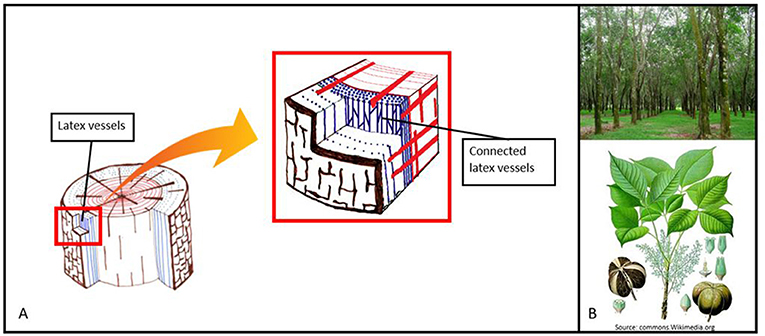
Figure 1 - (A) Enlarged longitudinal section of Hevea brasiliensis trunk section and attached tubes.
(B) A drawing of a Hevea brasiliensis plantation and its leaves, flowers and fruits.
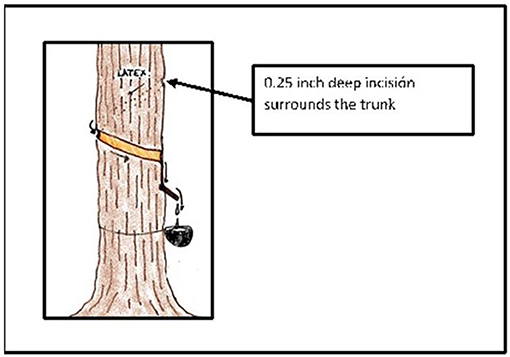
Figure 2- Hevea brasiliensis was made with a special incision for latex extraction
In 1839, Charles Goodyear invented vulcanization.
The process of treating the rubber with sulfur and heat to harden it while maintaining its flexibility solves most of the problems with rubber.
Vulcanization is the process of treating rubber with sulfur and heat to harden it while maintaining its elasticity. It prevents the rubber from melting in summer and cracking in winter. A few years after this important discovery, in 1888 Dunlop invented the air-filled rubber tire, making rubber an extremely important raw material worldwide. Rubber became an important material for the Industrial Revolution.
From 1850 to 1920, businessmen were pushing entrepreneurs and merchants to increase the amount of rubber extracted from Amazonian trees. During this period, the Brazilian Amazon was the sole source of rubber, and they controlled the price, making rubber expensive. At the same time, rubber had more uses as more and more industries developed in Europe and the USA [4]. Rubber was such an important material to Brazilians that they banned the export of rubber seeds or seedlings. But in 1876, HA Wickham smuggled 70,000 rubber seeds hidden in banana leaves and brought them to England. Only 1,900 seedlings survived from these seeds and were sent to Malaysia to start the first rubber plantations in Asia. This was the beginning of the end for Brazil as the world's main rubber producer. After 12 years, rubber production at new plantations in Malaysia was as competitive as those in the Amazon, and these plantations soon became the world's main suppliers of natural rubber (Figure 3).
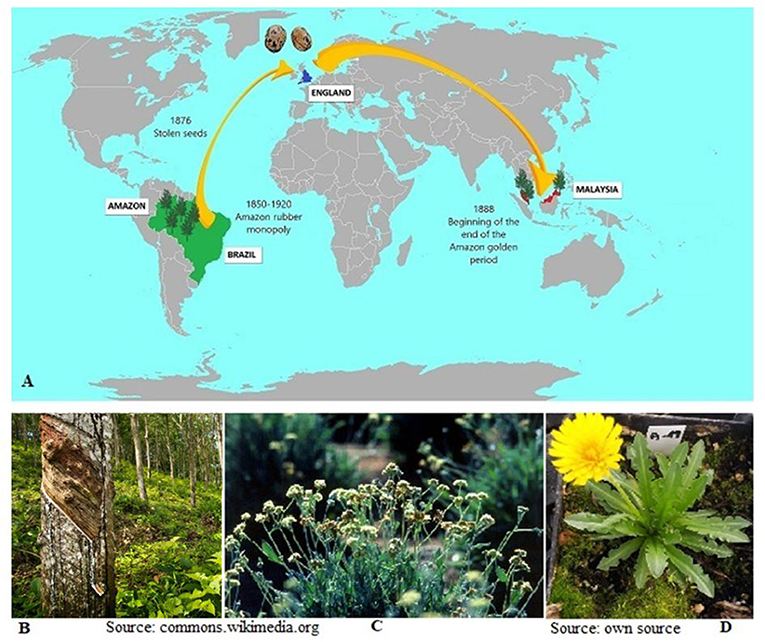
Figure 3 - (A) Hevea brasiliensis originated in the Amazon and traveled to Malaysia, the main natural rubber producer.
(B) Hevea brasiliensis. (C) An alternative source of rubber, guayule (Parthenium argentatum).
(D) An alternative source of rubber is the Kazakh dandelion (Taraxacum koksaghyz).
Henry Nicolas Ridley was a scientist who became director of the Singapore Botanic Gardens in 1888.
While working there, he found the first 11 rubber trees planted in Malaysia and began promoting the establishment of rubber tree plantations. After some time, Hevea developed a revolutionary method for collecting latex from tree by continuous tapping, which is the process of extracting latex from wood. This discovery resulted in a much higher yield of latex and rubber became an important material in Singapore's development. The new plantations were more competitive in price, so rubber harvesting from wild sources in tropical America declined drastically from the end of the nineteenth century to the First World War. During the war, the supply of rubber was cut off. The United States, Germany, Russia, and the Amazon began to look for alternative sources of rubber, natural or synthetic, because the trees were not supplying enough rubber for their needs [3]. Various research programs were initiated in these countries, but after the war, rubber supplies from Malaysian plantations resumed and the search for new rubber sources was virtually eliminated.
Today, about 90% of natural rubber is produced in Asia, with Thailand and Indonesia being the most important rubber suppliers. (supplying more than 60% of the world's natural rubber)


